
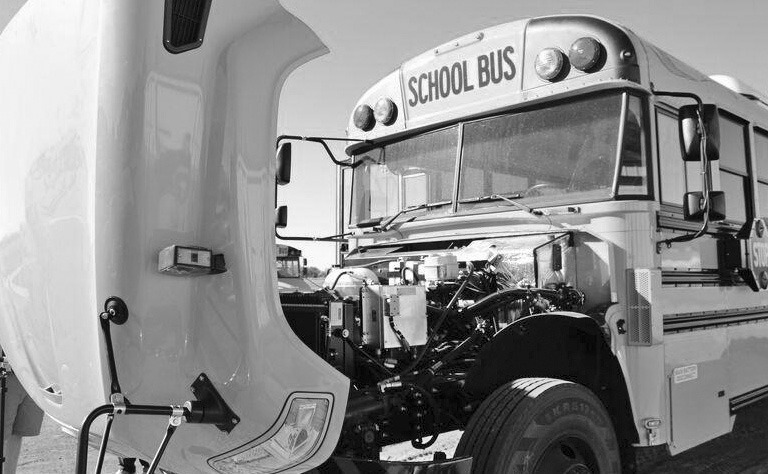
News Service The quietness is what stood out the most when John Eisenhauer drove the new school bus for the first time.
In fact, the bus is so quiet that when it goes below 17 miles per hour, it plays a loud, whining noise to alert other drivers.
Eisenhauer is the head of maintenance at Southern Public Schools in Gage County. The district is one of three in the state that received an electric school bus through a grant from the Environmental Protection Agency.
The Clean School Bus Program will award $5 billion nationwide through 2026 to replace existing school buses with zero-emission and lowemission models, according to the EPA website.
All 50 states have been awarded at least one electric bus through the program. Six Nebraska schools have been granted buses, but only three have received them.
Hershey Public Schools, McCool Junction Public School and Southern Public Schools each received their electric bus at the end of October, but Hershey is the only school that’s been able to use the bus for daily routes so far.
Hershey Superintendent Jane Davis credits the public power district’s involvement in the process from the beginning.
“They were champions in figuring out how the charging station would be installed and Davis said. “We did a lot of prework, getting it done before the bus showed up.”
For Davis, applying for the grant was a no brainer.
“Hershey’s always been innovative, and we’ve always approached technology as looking towards the future,” she said. “That was important to us. Clean energy is also important.”
Each of the three schools had to pay around $20,000 with district money for charging station installation. Davis said the money she was able to save for Hershey through the grant was a huge financial opportunity.
Electric school buses cost around $400,000, according to the United States Department of Energy. That’s three to four times more expensive than a diesel bus, which can cost around $50,000.
From Davis’ number crunching, she anticipates saving up to $800 a month by not having to pay for diesel fuel.
Those savings will continue growing, especially since electric school buses are supposed to have a longer lifespan as long as they are maintained properly.
But without grant funding to cover the current initial cost of the bus, all three superintendents agreed they wouldn’t be able to justify using taxpayer money to get one.
“In the 12 years that I’ve been here, we never bought a new bus. Ever. We always bought used buses,” Dade McDonald, McCool Junction superintendent, said. “Without the grant, this wouldn’t have been a possibility for us.”
McDonald said some lingering technical difficulties with the bus’ charging station mean the school hasn’t been able to use it yet, but he’s hoping to have it on routes soon.
“It’s just a learning process. Everybody wants something that’s new to work right away and to be great right away,” McDonald said. “I think it’ll be great and worthwhile — eventually.”
Once it’s up and running, it will need to travel around 40 miles for the morning route. Chris Prososki, Southern Public Schools superintendent, isn’t rushing things — he wants to ensure the bus can handle the route before students ride it.
Electric school buses take between six and eight hours to charge, according to Prososki. The bus can travel around 100 miles per charge.
The process has been a lot longer than Prososki expected, but he said he thinks that comes with being an early adopter in anything.
“We’re all kind of guinea pigs to see what works or doesn’t work,” Prososki said. “But just like everything else, I think eventually electric bus prices will go down and make them more viable.”
The Nebraska News Service is the state news and sports wire service provided by the University of Nebraska-Lincoln College of Journalism and Mass Communications.