
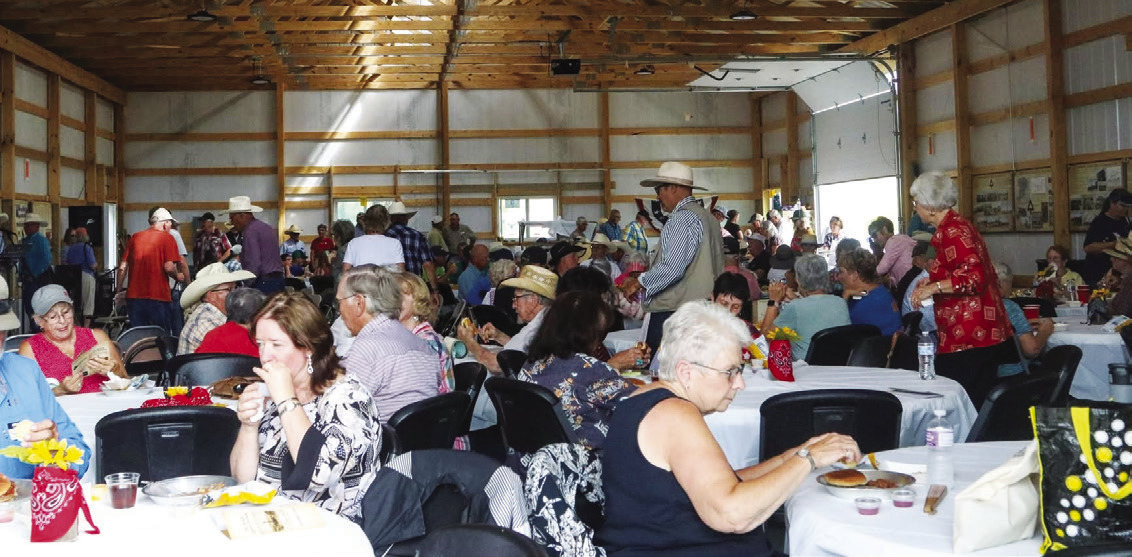
By Lisa Hare If you were fortunate enough to be one of the more than 400 people who stepped into the Ellsworth Bowling Alley or crossed the threshold of the historic Jonathan and Trenda Nielsen home—originally built in 1904 as Bartlett Richard’s summer home—then you already know the American West is not a static legend confined to history books; it is a living, breathing reality, shaped by land and labor, weather, and an enduring creative spirit.
At the recent Spade Ranch Reunion that took place on September 7 in Ellsworth and the surrounding community, a unique gathering of artists, ranchers, and historians converged to showcase the rugged beauty of the Sandhills, and celebrate the region’s heritage.
To behold the array of art works on display that day, is to understand the deep, cultural roots of Ellsworth itself. Long before it became the quaint, quiet village with its present-day 17 inhabitants, Ellsworth functioned as the absolute heartbeat of community life and the primary supply depot for the sprawling Spade Ranch. Constructed in 1898, the Richards & Comstock Company store anchored the entire settlement. Known simply as “The Office,” it featured a revolutionary telephone line that connected it directly to the Spade headquarters long before phone lines ever reached the wider Sandhills region. This critical communication lifeline plugged straight into the railroad’s telegraph and telephone networks, keeping the massive operation plugged into national markets.
The Office was more than just a freight stop, it was a buzzing outpost. Without the steady flow of supplies passing through this railhead, ranch operations simply could not function. Every Monday, Wednesday, and Friday, heavy freight lines packed with mail, staples, hardware, fencing, tack, and kerosene were systematically hauled 25 miles northeast to the main headquarters, before trickling out to cow and hay camps scattered across hundreds of square miles. The freight wagons would complete their grueling return trips on Tuesdays, Thursdays, and Saturdays.
This continuous infrastructure brought in a steady wave of people—initially ranch hands and later homesteading “Kinkaiders”—solidifying the company store as a true community center. Furthermore, the iconic Spade Ranch stockyards formed a massive gateway to national cattle markets. Thousands of cattle were trailed across the Sandhills each season, funneling directly into these stockyards to be loaded onto railcars and shipped east to major packing hubs like Chicago and Omaha. This extraordinary shipping efficiency allowed the Spade to scale into one of the single largest ranches in the entire nation.
It is this exact legacy of heavy labor, livestock, and grit that inspires much of the art displayed at the recent Spade Ranch Reunion. For many of the exhibitors at the event, art is a natural extension of daily ranch work.
In the Nielsen living room, husband-and-wife duo Seth and Jenna Adam of Hyannis displayed custom cowboy gear from their U Lazy U Leather Shop. Their hand-tooled saddles, chaps, and headstalls are built with a dual purpose: to stand out in the arena and to withstand the brutal demands of real working ranch life.
Down in the garage, rancher Mick Dubs shared a similar bond with leather. First learning the trade in a 1981 high school wood-shop class, Dubs stepped away from the craft for years until a severe accident in 1989 brought him back to it. Guided by local mentor Dave Hebbert, Dubs mastered the intricate art of braiding and tying halters. Now, whenever he isn’t tending to cattle, leatherwork fills his time, driven by a simple motto: “You’re only limited by what you know or think you can’t do!”
In the office, Fred Hagman’s work reflected a lifetime spent around livestock on the Pine Ridge Indian Reservation and his current cow/calf operation at Hairpin Ranch. Making western belts since 1968, Hagman’s leather pictures have earned national recognition, bridging the gap between functional gear and gallery art.
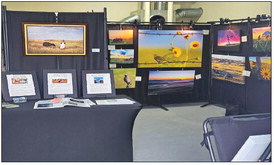
While some shape leather, others use lenses and brushes to translate the vast Nebraska landscape. Over at the Ellsworth Bowling Alley, fine art photographer Audrey Powles—a self-taught rancher from the western Sandhills—exhibited photographs that merge the dramatic atmosphere of classical oil paintings with authentic, contemporary ranch moments.
Beside her, Nicole Louden, the voice behind the Sandhills Prairie Girl blog, shared the quiet rhythms of cattle ranching through essays and imagery. Though Louden did not grow up in agriculture, her deep connection to the land resonated clearly in her featured works, which have graced the pages of “Nebraska Life” and “Nebraska Land” magazine.
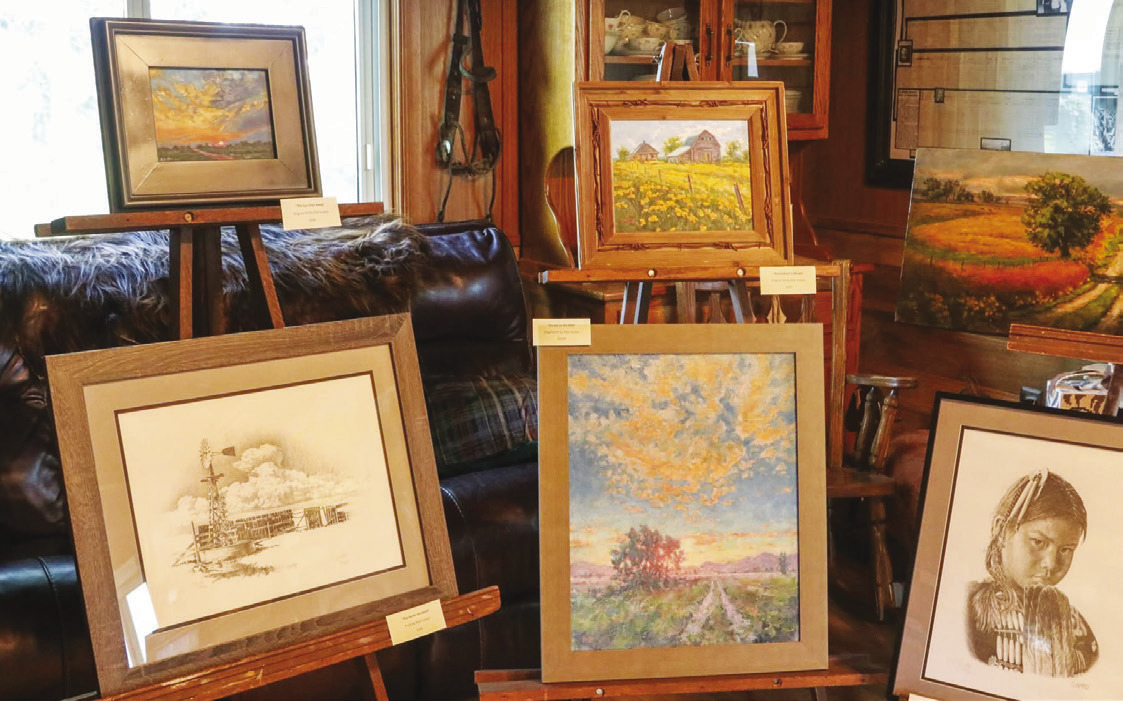
In the living room, local painter Rick Yusten captured the region’s vaulted skies and wide vistas. Painting outdoors on “country jaunts,” Yusten’s oil paintings present the West as a place defined by solitude, memory, and time.
In the apartment living room, retired rancher and collector Jerry Underwood brought a rare piece of the past to light. While Underwood jokingly claims he missed the artistic gene— remarking that if he tried to draw a stick man, “it would look like a tumbleweed hit by an F-250 truck”—his passion for Western history led him to preserve the incredibly scarce work of Nebraska native Howard H. Hall. Hall, who ranched and worked alongside legendary cowboy artists like Charles Russell, died tragically of typhoid fever in 1916 at age 32, leaving behind a rare, brilliant footprint in Western art.
The event also honored late local legends like Shirley L. Wilcox. A former Alliance art teacher who married into a Sandhills ranching family, Wilcox created stunning western scenes and illuminated manuscripts. She famously viewed her paintings as her “children,” choosing to paint for her own passion rather than the public eye.
Meanwhile, hanging in the bedrooms, the intricate designs of the Willow Tree Quilt Guild reminded attendees that art has always kept the Sandhills warm. Based out of Gordon, the guild’s community exhibitions and historical pattern preservation serve as a living, stitched record of local history.
From Tom Shrewsbury’s whimsical, handcrafted wooden playsets to Linda Lacy’s masterlevel pottery and clay creations, the Spade Ranch Reunion proved that creativity thrives in the rural heartland. In the Sandhills, art isn’t just something to look at—it’s an extension of an interconnected history, crafted one piece, one stitch, and one day of labor at a time.
The reunion also served as a deep dive into local history.
“It really was like a big reunion, people sitting around talking, telling stories. It was more than just a Spade Reunion, it was more of a Sandhills reunion,” said event co-organizer Steve Cleveland.
Others actively involved in organizing and hosting the event included Pepper Shrewsbury, Stephanie Graham (owner of Schoolhouse Museum); Jonathan and Trenda Nielsen (current owners and occupants of the Bartlett Richard’s summer home in Ellsworth, allowed tours and hosted art exhibits); Becky Herian (made introductions and helped with event exhibits); Wade Morgan (opened his store, sold souveneirs, shared stories); Becci Thomas at the Knight Museum also helped organize the event, and Jana Jensen of Bingham helped serve the meal to more than 360 people that ate lunch at the event.